
The common order from highest to lowest is trail (three of a kind), pure sequence (straight flush), sequence (straight), color (flush), pair, then high card. Compare category before card values; sequence order and tie handling can vary by table.
The six categories, at a glance
01 · Trail
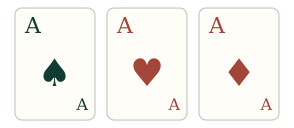
Three cards of the same rank.
02 · Pure sequence
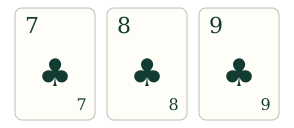
Consecutive ranks in the same suit.
03 · Sequence
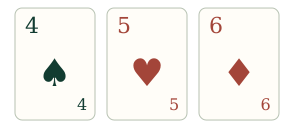
Consecutive ranks in mixed suits.
04 · Color
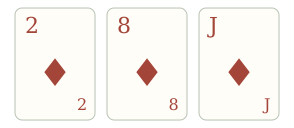
One suit, without a sequence.
05 · Pair
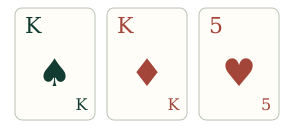
Two matching ranks plus a kicker.
06 · High card
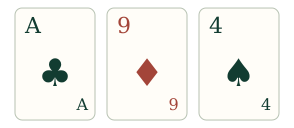
No higher combination.
One-minute knowledge check
Which category is stronger in standard Teen Patti?
Choose an answer. No account, stakes or scoring history.
The usual order, highest to lowest
In the commonly used ranking, a trail (also called a trio or three of a kind) beats a pure sequence (three consecutive cards of one suit). A pure sequence beats a regular sequence (consecutive ranks in mixed suits), which beats color (three cards of one suit that are not consecutive). Color beats a pair, and a pair beats a high card hand.
- Trail
- Pure sequence
- Sequence
- Color
- Pair
- High card
These labels and the broad order are widely used, but house rules can differ. If a game provides a hand-ranking panel, use that table’s own rules.
Six examples, one for each category
Here are sample three-card hands. Each example illustrates a category; it is not a screenshot or a claim about any particular app.
- Trail: A♠ A♥ A♦ — three aces.
- Pure sequence: 7♣ 8♣ 9♣ — consecutive ranks, all clubs.
- Sequence: 4♠ 5♥ 6♦ — consecutive ranks, mixed suits.
- Color: 2♦ 8♦ J♦ — all diamonds, not consecutive.
- Pair: K♠ K♦ 5♥ — a pair of kings.
- High card: A♣ 9♦ 4♠ — no pair, flush, or sequence; ace is the highest card.
With these examples, the trail beats the pure sequence even though the latter is consecutive and suited. Category takes priority over the apparent strength of individual cards.
How to compare hands in the same category
First identify each hand’s category. If the categories differ, the higher category wins under the usual order. If they match, compare the relevant ranks from highest downward; do not jump straight to suit.
- Trails: compare the rank of the three matching cards. A-A-A beats K-K-K.
- Pairs: compare the pair first, then the remaining kicker if the pair ranks tie. K-K-5 beats Q-Q-A because kings outrank queens; K-K-A beats K-K-9 on the kicker.
- Colors and high cards: compare the highest card, then the next-highest, then the third, as applicable. A-J-8 beats A-10-9 when both are color hands of different suits, because the second card decides.
- Sequences: compare their top rank according to the table’s sequence convention. Do not assume an ace-low sequence or its order without checking.
For example, compare 9♣ 9♦ 3♠ with 9♥ 9♠ 2♦: both are pairs of nines, so compare the kickers; 3 beats 2. Suits do not change that result under ordinary rank-based tie comparison.
A-K-Q versus A-2-3: sequence order is table-dependent
Ace placement is a notable variation. Some tables treat A-K-Q as the highest sequence and A-2-3 as the next-highest; other tables use a different sequence ranking or special ordering. There is no safe assumption that every Teen Patti table or app applies the same convention.
Before comparing sequences, check whether ace can be high, low, or both, and how the table orders A-2-3 against other runs. If the rules do not say, ask before play rather than inferring from a hand example elsewhere.
Suits are not a universal tie-breaker
Teen Patti does not have one universal suit hierarchy that settles every tied hand. Some local or table-specific rules may define a suit order or another tie procedure; others may treat the hands as tied. Do not presume spades always outrank hearts, or that a suit can break a tie, unless the rules for that table explicitly say so.
When two hands appear equal after comparing the category and relevant card ranks, follow the stated tie rule. If no tie-break is specified, do not invent one.
A quick comparison checklist
- Read the table’s rules for ace sequences and ties.
- Classify both hands: trail, pure sequence, sequence, color, pair, or high card.
- If categories differ, use the category order.
- If categories match, compare the category’s card ranks in order, including a kicker where relevant.
- Use suits only if that table explicitly gives them a role.
This method helps you compare shown hands without relying on app graphics, a supposed universal suit order, or a rule variant from another table.
For the wider hand structure, see Teen Patti rules; for general decision-making, see the strategy guide or FAQ.
Questions answered
Does a trail beat a pure sequence?
Yes, in the commonly used ranking: trail is above pure sequence. Check the specific table’s rules if it uses a variant.
Is A-2-3 always the second-highest sequence?
No. Ace placement and the order of A-2-3 versus A-K-Q can depend on the table. Check the sequence rules before comparing.
Can suits break a tie in Teen Patti?
Not universally. A table may define a suit hierarchy or another tie procedure, but do not assume one unless its rules state it.
How do I compare two pairs?
Compare the pair ranks first. If those tie, compare the remaining kicker; use a suit only if the table explicitly makes suits relevant.
Sources & scope
Sources support the stated explanations. App descriptions are publisher claims, not first-hand test evidence.